 1 month ago
28
1 month ago
28
Dear subscriber,
Recent developments across Indonesia’s digital ecosystem show a market that is not only growing, but becoming more structured and resilient. Stronger fintech regulation, continued healthcare investment, and capital market reforms are improving trust, governance, and long-term scalability. At the same time, innovation from players like Alfamart in quick commerce highlights how consumer experience continues to evolve.
At a regional level, Southeast Asia is also moving beyond user growth, with platforms playing a more central role in how people work, sell, and transact. The Digital Frontiers 2030 report underscores how digital entrepreneurs are emerging as key drivers of this shift, signaling a transition toward a more open, platform-driven economy.
Thanks for reading RISE by DailySocial! Subscribe for free to receive new posts and support my work.
CRM, project management, financial tracking, AI-powered campaigns, automated reporting & more — 10+ modules, fully interconnected. Projects link to tasks, contacts link to deals, transactions link to budgets. Nothing exists in isolation. Take control today at Blacksite!
Stay ahead,
DailySocial Team
Indonesia’s competition watchdog KPPU has taken a decisive stance against anti-competitive practices, finding 97 online lenders guilty in an interest rate cartel case and issuing significant penalties. The ruling, which includes fines totaling around $44 million, signals a stronger push toward transparency and fair lending practices across the fintech sector. This development highlights growing regulatory maturity as digital lending continues to scale rapidly. For Indonesia’s ecosystem, it reinforces trust as a foundational layer, especially critical as fintech moves from hypergrowth to sustainability. In the long run, this could accelerate consolidation while pushing platforms to design more independently governed, compliance-first models that balance innovation with market fairness.
Regional healthcare platform expansion continues as KV Asia scales its footprint with a new hospital investment in Indonesia, signaling sustained investor confidence in the country’s healthcare-tech convergence. The move reflects a broader trend where private capital is flowing into hybrid models that combine offline infrastructure with digital services (read more via ). As healthcare demand rises alongside digital adoption, operators are increasingly integrating tech-enabled patient journeys and data systems. For Indonesia, this reinforces its position as a key growth market for healthtech and infrastructure plays. The intersection of healthcare, data, and platformization is becoming a compelling frontier for long-term value creation.
Indonesia’s capital market is entering a new phase with the enforcement of a minimum 15% free float requirement, aimed at improving liquidity and governance standards among listed companies. The regulation, effective end of March 2026, is expected to broaden investor participation and enhance market depth (more via ). This policy shift aligns with global best practices, encouraging more transparent and investable public companies. For the local tech and startup ecosystem, it potentially opens clearer exit pathways through IPO readiness. Over time, this could strengthen the overall capital formation cycle and attract more institutional interest into Indonesia’s digital economy.
Alfamart is doubling down on quick commerce to reignite growth, leveraging its extensive minimart network to compete in the evolving on-demand retail space. By integrating faster delivery models and digital ordering, the company is adapting to changing consumer expectations shaped by convenience and immediacy. This reflects a broader shift where traditional retail players are transforming into hybrid offline-online platforms. In Indonesia, where proximity retail is deeply embedded, this strategy could unlock a powerful distribution advantage. It also signals that the next phase of “new retail” will likely be won by players who can merge logistics, data, and physical presence seamlessly.
Nikkei

Southeast Asia is entering a defining decade of digital acceleration, with its digital economy projected to reach $1 trillion by 2030, and potentially $2 trillion as regional integration deepens. The 2030: Unlocking Opportunities from Southeast Asia’s Digital Acceleration report highlights how converging technologies such as AI, real-time payments, and programmable money are reshaping how businesses operate and how consumers engage. At the center of this transformation is a young, mobile-first population that is increasingly entrepreneurial and digitally native. This shift is moving the region from product-based models to solution-driven ecosystems powered by platforms, data, and partnerships. The result is a more dynamic and competitive landscape where speed, personalization, and integration define success.
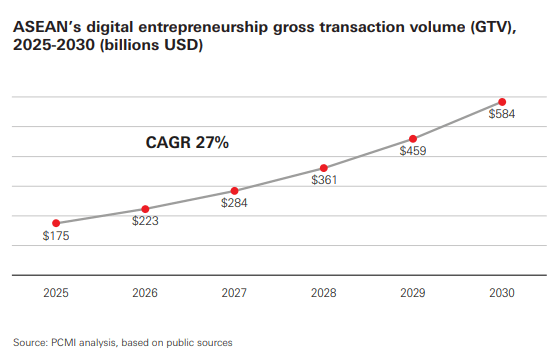
One of the strongest drivers is the rise of digital platforms and entrepreneurs, with 75 million digital sellers contributing around $175 billion in transaction value, representing over half of ASEAN’s digital economy today . At the same time, consumer expectations are rapidly evolving, with 67% prioritizing speed in payments, 66% wanting more BNPL options, and 77% already using embedded finance. Real-time payments and digital wallets are becoming the default, while cross-border payment volumes are expected to double by 2030. Emerging technologies such as AI-driven personalization and automated commerce are also beginning to reshape how transactions happen. Together, these trends point toward a future where commerce is faster, more flexible, and increasingly seamless.
For Indonesia, these shifts reinforce its position as a key engine in the region’s digital economy, supported by a large base of digital entrepreneurs, mobile-first users, and rapidly expanding platform ecosystems. The report suggests that markets like Indonesia are well positioned to benefit from platform-led growth, embedded finance adoption, and real-time payment infrastructure. As digital platforms expand into sectors such as healthcare, logistics, and financial services, the opportunity lies in building integrated ecosystems rather than standalone products. At the same time, investments in cloud infrastructure, talent, and governance will be essential to sustain growth. Overall, the outlook remains highly positive, pointing to a future where Indonesia plays a central role in shaping Southeast Asia’s digital evolution.