 1 month ago
33
1 month ago
33
Dear subscriber,
Hi everyone, hope this finds you well. This week, Indonesia's tech and capital landscape is sending strong signals across media, retail, and sovereign investment. IDN is merging digital and physical culture with its M Bloc acquisition, global private equity is backing Indonesian retail through the MAPI deal, and INA is posting a profit surge alongside fresh banking leadership. On the horizon, Danantara's clean power export plan and a strong Q1 GDP print round out an optimistic picture. Let's dive in.
Thanks for reading RISE by DailySocial! Subscribe for free to receive new posts and support my work.
On July 1–2 at AXA Tower – Kuningan City Grand Ballroom, Jakarta, B2B Tech Asia Expo 2026 returns with a sharper, sector-first format: 10 specialized industry zones built around finance, logistics, healthcare, retail, enterprise IT, and beyond — each designed to connect the right buyers with the right solutions. Hosted by VRIGroup and DailySocial, with sponsors and exhibitors including AWS, Salesforce, SoftBank, SMBC, Jenius, Mekari, and Zoho, it remains Southeast Asia’s largest expo built exclusively around B2B software.

Find your zone. Meet your buyer. Register now at b2btechasia.com.
Stay ahead,
DailySocial Team
IDN Acquires M Bloc Group, Merges Digital and Physical Culture Media and entertainment tech company IDN has officially acquired M Bloc Group, Indonesia’s leading placemaking network for culture, creativity, and community. The acquired portfolio, including M Bloc Space, Pos Bloc Jakarta, Surabaya, and Medan, and Lokananta Bloc Solo, will operate under a unified platform called IDN Bloc while keeping each venue’s identity intact. The move gives IDN a physical canvas to connect brands and communities with Gen Z, integrating with assets like JKT48, Saweria, and Pestapora. For Indonesia’s creator economy, it signals a maturing thesis that digital media and physical cultural spaces are stronger together. Expect more ambitious content, events, and creator collaborations to flow from this combined ecosystem.
JALA Tech Backer Seeks US$30M for Aquatech Roll-Up A backer of Indonesian shrimp-farming startup JALA Tech is raising around US$30 million to build a new aquatech roll-up platform consolidating smaller independent tech firms with strong local networks. The strategy targets fragmented aquaculture technology players, aiming to scale distribution and data across one of the world’s largest shrimp-producing nations. JALA itself has monitored shrimp across more than 35,000 water bodies for roughly 20,000 users, showing the depth of demand for digitized cultivation. A consolidation play makes sense in a sector where scale and traceability unlock global market access. For Indonesia’s blue economy, this points to a more mature, investable aquatech landscape ahead.
MSCI Removes Six Indonesian Stocks, IDX Stays Optimistic MSCI’s May 2026 review removed six Indonesian names from its Global Standard Index, including Amman Mineral, Barito Renewables, and Chandra Asri, with the changes effective after May 29. The reshuffle is a short-term consequence of transparency and free-float reforms pushed by IDX and OJK, including the new High Shareholding Concentration framework. IDX interim CEO Jeffrey Hendrik framed it as near-term pain for long-term gain, expressing optimism about the structural payoff. Cleaner ownership disclosure and deeper free float are exactly what international investors have asked of Indonesia for years. The reforms position the market for healthier, more durable foreign participation once the dust settles.
Pacific Universal Becomes New Controller of MAPI Singapore-based Pacific Universal Investments, affiliated with private equity giant CVC Capital Partners, has acquired a 51% controlling stake in retail powerhouse Mitra Adiperkasa (MAPI) for Rp11.81 trillion. A mandatory tender offer to public shareholders has been set at Rp1,550 per share, a premium of around 22% over MAPI’s 90-day average trading price. The acquirer’s stated goal is to grow the MAPI group across Indonesia and the wider Southeast Asia region. Global institutional capital backing one of Indonesia’s largest lifestyle retailers is a strong vote of confidence in domestic consumption. For the retail sector, it signals that Indonesia’s consumer story remains a magnet for serious long-term investors.
INA Posts 37% Profit Surge, Names Banking Veteran as CEO Indonesia Investment Authority (INA) reported a 37.3% jump in 2025 net profit to Rp7.45 trillion, with revenue up 43% to Rp8.45 trillion and assets under management reaching Rp146.2 trillion. The sovereign fund deployed capital across infrastructure, green energy, digital infrastructure, and advanced materials, while catalyzing significant foreign direct investment. In parallel, INA named investment banker Oki Ramadhana, ex-Goldman Sachs, Morgan Stanley, and Mandiri Sekuritas, as CEO, with Laksono Widodo as CIO and Adhiputra Tanoyo as CRO. The combination of strong returns and a deep-bench leadership team strengthens INA’s credibility with global co-investors. For Indonesia’s capital-formation engine, this is momentum that compounds.
Indonesia to Export Clean Power to Singapore in Rp522T Project Sovereign fund Danantara revealed Indonesia plans to export clean electricity to Singapore, with the project targeted to begin by end-2026 and an estimated investment value of around US$30 billion (Rp522.79 trillion). CIO Pandu Sjahrir said six to seven companies have already secured conditional licenses from Singapore, with the roughly 3 gigawatt solar capacity also serving domestic needs. The plan anchors Batam, Bintan, and Karimun as a new green industrial hub, attracting high-tech manufacturing alongside energy exports. With Singapore power tariffs far above Indonesia’s, the margin potential and FDI pull are substantial. For Indonesia’s energy transition, this turns abundant green potential into a regional export advantage.
TransFi Expands Stablecoin Cross-Border Payments Into SEA Dubai-based fintech TransFi has launched BizPay, a conversational cross-border payments platform for SMEs across Indonesia, Malaysia, Vietnam, and the Philippines. Built on stablecoin-powered rails with AI routing, it lets businesses collect and pay out via WhatsApp or Telegram, with TransFi having processed over US$1 billion in volume and raised US$19.2 million. The timing tracks regional momentum, with Indonesia joining BIS Project Nexus in February and ASEAN remittance interoperability advancing. For Indonesia’s SMEs and freelancers, cheaper and faster cross-border settlement removes a long-standing growth bottleneck. As QRIS and stablecoin rails converge, Indonesia’s payment ecosystem keeps getting more globally connected.
Indonesia’s economy expanded 5.61% year-on-year in Q1 2026, marking an acceleration from the 5.39% recorded in Q4 2025 and the strongest quarterly growth print in over two years. The headline number from the official BPS release signals an economy gaining real momentum, with growth broad-based across nearly all sectors. The quarter-on-quarter contraction of 0.77% is a routine seasonal effect, largely driven by the normalization of government spending after year-end, not a sign of underlying weakness. Nominal GDP reached Rp6,187.2 trillion, underscoring the sheer scale of Southeast Asia’s largest economy.
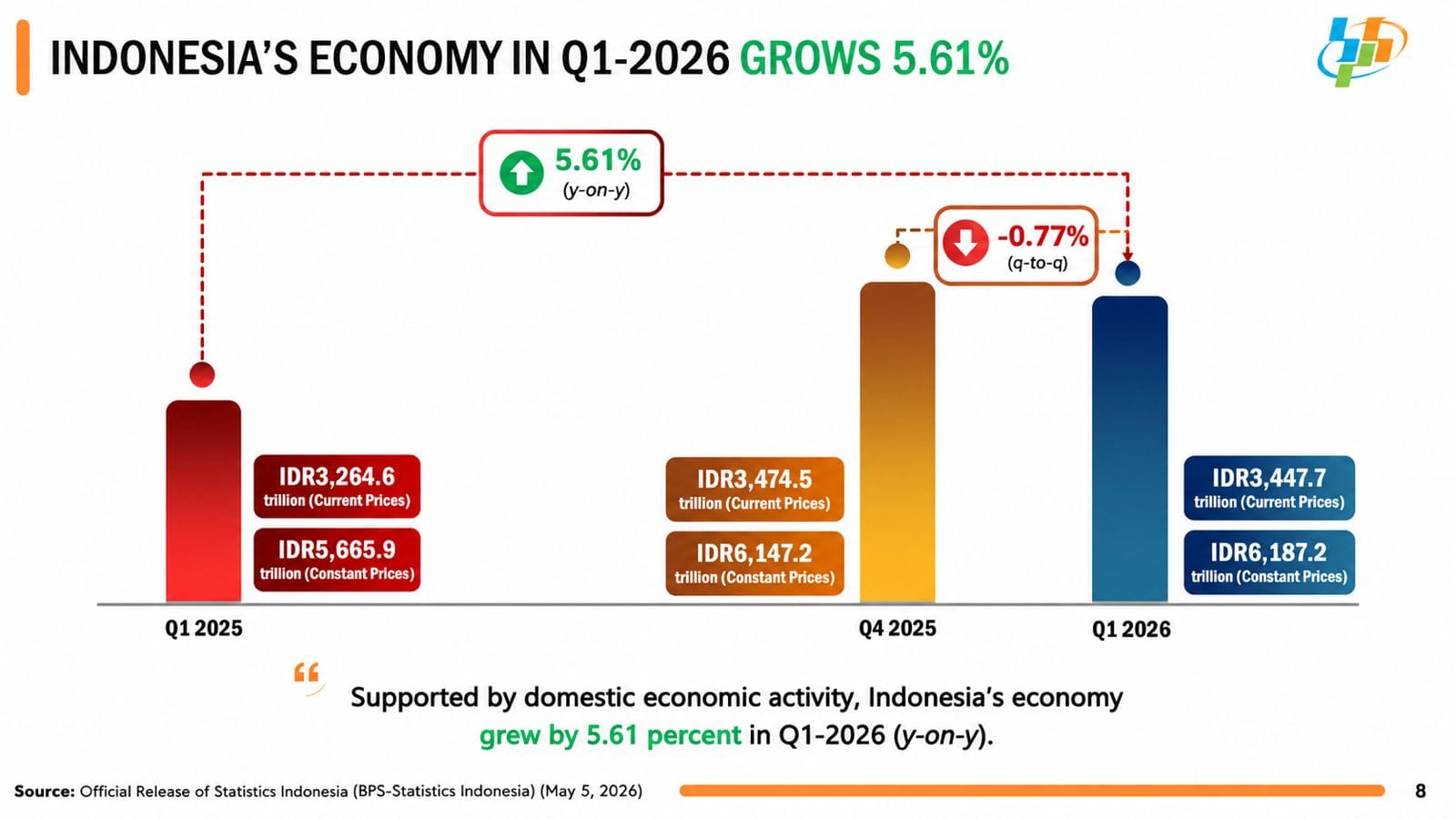
The data tells an encouraging story across the board. Accommodation and food services led all sectors with 13.14% growth, followed by other services at 9.91% and transportation and warehousing at 8.04%, a clear signal that consumer-facing and mobility-driven activity is thriving. Manufacturing, the economy’s dominant sector at roughly 19% of GDP, grew a solid 5.04%, while household consumption, which makes up more than half of GDP, rose 5.52%. On the expenditure side, government consumption surged 21.81% year-on-year and gross fixed capital formation grew 5.96%, pointing to both fiscal support and healthy investment appetite. Spatially, Bali and Nusa Tenggara posted the fastest regional growth at 7.93%, while Java continued to anchor the economy with a 57.24% contribution and 5.79% growth.
For Indonesia’s tech and digital ecosystem, this macro backdrop is a tailwind. The standout performance of accommodation, food services, transportation, and trade maps directly onto the demand engines that power platforms like Grab, GoTo, and Blibli, validating why ride-hailing and e-commerce demand has stayed structurally resilient. Information and communication grew 7.14% and continues to expand its GDP share, reflecting the deepening digitalization of the economy. Strong household consumption and robust investment formation create fertile ground for fintech adoption, data center capex, and the AI infrastructure wave already underway. A 5.61% growing economy with consumption and investment both firing is exactly the foundation Indonesia’s digital economy needs to keep compounding.